

Colonial Revival is a popular architectural style in the United States because of its varied styling and inherent eloquence. The name reflects the late-19th-century fascination with homes built by the early English and Dutch settlers, an affection that intensified through World War I and II before ebbing in the mid-1950s.
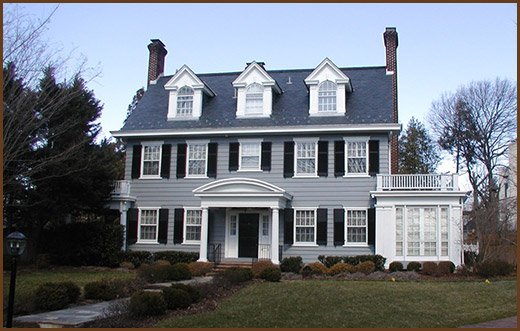
Colonial Revival is essentially a mixture of styles, all uniquely American. Varied roof forms such as gabled, hipped, and gambrel signify the style’s diversity, allowing a greater degree of adaptation when remodeling than more rigidly defined styles.
Check out two Colonial home kitchen remodels Wentworth completed in Chevy Chase and Bethesda — or keep reading to learn more about the Colonial Revival style.
If your Colonial Revival home in Chevy Chase needs restoration, contact Wentworth at (240) 383-1227.
Characteristics
Colonial Revival homes built in the first wave of construction between 1880 and 1945 tend to be professionally designed and often boast interesting architectural details fashioned from highly durable materials. The so-called Neo-Colonials built during the movement’s second wave after 1945 tend to dominate many newer suburbs. They are often plainer, less detailed, and more assembled than crafted. Neo-Colonials also reflect the common practice of constructing a brick facade on a structure otherwise wrapped in aluminum or vinyl siding.
Please view our portfolio to see Colonial Revival and other style homes Wentworth has remodeled in the Washington, DC, metro area.
Materials
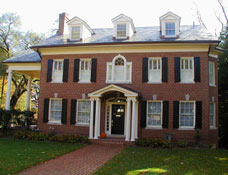
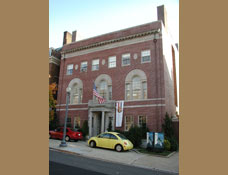
Clapboard and shingle siding is often found in the Colonial Revival style, but brick is the preferred material. This is especially true for homes built after 1920, when brick veneer construction made using brick more affordable. A fine example of Colonial Revival architecture executed in brick and stone is the Woodrow Wilson house at 2340 S. St. NW in Washington, DC. This home was designed by architect Waddy Wood and built in 1915. An attractive brick center-hall Colonial Revival, built in the 1920s, can be seen at 3400 Newark St. NW.
Roofs
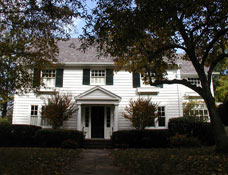
Gable roofs are the typical roof form found in Colonial Revival homes, followed by gambrel and hip roofs. Slate shingles were commonly used until around World War II, when asphalt shingles became a popular, cost-effective alternative.
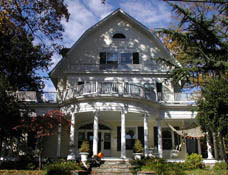
Many of Washington, DC’s Colonial Revivals are detached two-story homes with a center hall and simple gable roof. An excellent example of a center-hall Colonial Revival stands at 7 Magnolia Pkwy. in Chevy Chase, MD.
Gambrel roofs are the next most common. An excellent example of a Colonial Revival with a front-facing gambrel roof built circa 1900 is found at 3225 Highland Place NW in Cleveland Park. The final portion of Colonial Revival homes in DC feature hip roofs that slope on all four sides.
Subtypes featuring variations of the primary roof forms also exist. For example, larger Colonial Revivals often have an asymmetrical facade to accommodate an attached garage or porch. The result is a more complicated and interesting roof form.
Windows
Windows are designed simply, although they never reproduce the original Colonial Style. This is primarily because, by the late 19th century, glass manufacturers had learned how to produce larger, more functional windowpanes. Thus, most windows in Neo-Colonial homes are double-hung, with each sash consisting of six, eight, nine, or 12 panes. Single-pane lower sashes are also standard.
Entrances
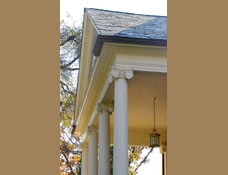
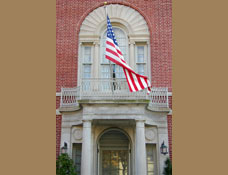
Colonial Revivals frequently present a notable decorative entrance. This may consist of a paneled front door flanked by sidelights, a broken pediment over the door, a modest portico with columns, and perhaps a pediment supported by pilasters.
Visit our glossary of architectural terms for more home construction and architecture vocabulary and definitions.
If your Colonial Revival home needs repair or restoration, call Wentworth at (240) 383-1227.
Colonial Revival Home Remodeling in VA, MD & DC
Whether you just bought a historic Colonial Revival in the DC metro area or you’ve lived in your historic home for years, Wentworth would be pleased to help you update the interior and façade. We specialize in period home remodeling, so you can trust us to honor the original style while making the interior more suitable for 21st-century living. Here are the Colonial Revival home remodeling services we offer:
- Colonial Revival home remodeling: Is a more welcoming kitchen or functional bathroom at the top of your wish list? Wentworth can deliver everything you hoped for and more with our remodeling services for Colonial Revival homes.
- Colonial Revival home additions: If you envision adding a room or entirely new wing to your house, Wentworth is the remodeler for you. We aim to create seamless additions that stay true to the original architecture.
- Colonial Revival interior reconfigurations: Home layouts designed 50 to 100 years ago often don’t meet today’s standards. We can preserve the grand entrance and polished wood floors of your Colonial Revival while modifying the floor plan to remove wasted space and improve traffic flow.
- Custom Colonial Revival detailing: Don’t let damaged railings, millwork, and plaster put a damper on your home. Our craftsmen can revitalize the space by implementing historically accurate detailing.
- Colonial Revival interior design services: Colonial Revivals lend themselves to traditional interior design. If you’re unsure how to pick furniture, paint colors, and accessories to match your historic home, Wentworth’s interior design services are perfect for you.
- Facade enhancements in the Colonial Revival style: The key to enhancing a Colonial Revival’s curb appeal is to use the same materials builders used when they built your home. At Wentworth, we never stray from authentic, high-quality materials when embellishing your home’s exterior.
Are you ready to start your Colonial Revival renovation project? If so, don’t hesitate to get in touch with us for a consultation!
Frequently Asked Questions