

With its long history in America, the Georgian style is among our country’s most consistently popular architectural styles. Admired for its symmetrical design, classic proportions, and decorative elements, it’s commonly associated with the reigns of England’s King George I, II, and III. However, in reality, it is directly tied to the work of English architect Sir Christopher Wren. Unmistakably the dominant architectural trend in the colonies between 1700 and the Revolutionary War, Georgian popularity slowed dramatically as architectural tastes began to change with the establishment of the United States and the emergence of the American Federal style.
Early generations of Georgian buildings have generally been lost to development in the more prosperous northern cities of Boston, New York, and Philadelphia. The best remaining examples of original Georgian architecture are in such eastern seaboard cities as Annapolis and Williamsburg, where a less affluent economy helped protect them from demolition. One of the best examples of the Georgian style in Greater Washington, DC, is Gunston Hall on the banks of the Potomac River in what is now Lorton, Virginia. It was built for George Mason, one of this nation’s Founding Fathers, whose work greatly influenced the Constitution and its Bill of Rights. Mason moved into Gunston Hall in 1759.
Much of the inspiration for Gunston Hall came from pattern books from England. These books were an early form of how-to manuals imported from Europe by colonial builders at a time when professional design advice was scarce. Such manuals played an enormous role in spreading the Georgian style throughout the colonies. Typically, pattern books focused on the design details for windows, doors, fireplaces, and molding elements, which were adopted or modified by the builder. With only a few professional-looking flourishes, colonial Americans could significantly enhance the appeal of their simple buildings. As the practice evolved, colonial builders also learned how to arrange building forms.
The basic Georgian proportion was typically geometrical, with the main block of the building frequently augmented by hyphens and wings. The axial symmetry of this style will always be a safe design approach. However, this static configuration does not necessarily optimize the actual functioning of a home. The somewhat-less symmetrical Federal style that followed was likely in response to this problem.
Schedule a consultation with Wentworth Studios or call (240) 383-1227 if you’re interested in remodeling your Georgian-style home, or keep reading to learn more about Georgian architecture!
Characteristics
The Georgian style utilizes many of the hallmarks of Renaissance design, such as rigid symmetry in building mass, window and door placement, and room layout.
Materials
Not surprisingly, interpretations of the Georgian style vary by location. In northern states, for instance, it’s common to see wood clapboard or shingle cladding. Occasionally, the corners of Georgian buildings are decorated with wooden quoins to imitate stone. Sometimes, stone and stucco are found in place of wood.
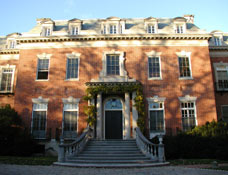
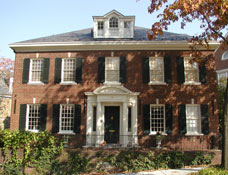
In the South, Georgian houses are occasionally constructed of stone and stucco, but this style more often features a brick facade. The brickwork sometimes includes a horizontal belt course between the first and second floors. A classic example of a Georgian with brick detail is Westover Plantation in Charles City County, Virginia. It’s a house of exquisite proportions and detail built on the bank of the James River. A more local example of the style, built in the 1920s, is found at 10 Kalorama Circle NW, Washington, DC.
Roof
A hip roof, sometimes with dormers, typifies the Georgian style. Because of the strict symmetry, a more asymmetrical gable roof would be noticeably inappropriate. The hip roof was popular with Christopher Wren and all who admired and emulated his design rules. Builders seeking variation sometimes include balustrades further embellished with decorative moldings and trim.
Windows
Double-hung windows with divided lights — usually 12 over 12 or 9 over 9 — are the standard in the Georgian style. Georgians built of wood often have decorative pediments over the windows, while brick Georgians feature ornamental brick headers.
Entrance
As a vehicle for decoration, Georgian home entrances are often fitted with pediments, broken pediments, arched tops, or ogee caps. In the North, wooden pilasters often flank the entrance, while in the South, doorways are typically enhanced with tasteful brick patterns.
Learn more architectural terms and vocabulary. Then, view photos of Georgian and other style homes we’ve remodeled in the Washington, DC, area.
If you’re looking to remodel your Georgian home in DC, MD, or VA, contact Wentworth Studios or call (240) 383-1227
Georgian Design-Build Services in Washington, DC, MD & VA
Are you the proud owner of a historic Georgian home? You may adore the original brickwork and relish the symmetrical design, but you might not be a fan of the leaky windows or cramped, closed-off kitchen. As a specialist in Georgian home renovations, Wentworth can repair and modernize your home for the 21st century while staying true to its historical roots. Here are some of the projects we have experience completing:
- Georgian home remodeling: Just because you live in a 200-year-old house doesn’t mean you can’t have an up-to-date interior. Our services allow you to enjoy modern kitchen and bathroom amenities, low-maintenance flooring, efficient windows, and better insulation, all set within a historically accurate Georgian backdrop.
- Georgian home additions: Does your family need more room to spread out? A Georgian home addition may include symmetrical wings on either side of the original structure to stay true to this design style.
- Georgian interior reconfigurations: The layouts of older homes often don’t meet the needs of modern families. We can help you make the most of every square foot by reconfiguring the interior. Rest assured that we use historically accurate materials and finishes to maintain the charm of your Georgian home.
- Custom Georgian detailing: Whether you want to replace the fireplace mantelpiece, install a stair railing, or add crown molding, we’ll work within the confines of the Georgian style to incorporate beautiful new embellishments inside your home.
- Georgian interior design services: The furnishings of a historic Georgian home don’t have to look dated. If you need help selecting paint colors, materials, furniture, and accessories, turn to Wentworth. Our interior design services create a coherent, functional living space that keeps the Georgian style front and center.
- Façade enhancements in the Georgian style: If you want to create a grand entrance to your home or repair the existing stone, stucco, or brickwork, Wentworth is the remodeling company to call. We can expand your front porch, add a second-story veranda, install functional window shutters, replace damaged pillars, and much more.
Check out our portfolio to see photos of Georgian homes and other historic styles we specialize in.
If you’re ready to begin your home renovation, schedule a consultation with us or call (240) 383-1227 today!
Frequently Asked Questions
Can Wentworth recreate and replace wooden quoins?
Wooden quoins are a beautiful decorative feature. Unfortunately, they are also a delicate and tasty feature for termites and many pests. Our skilled craftsman can remove damaged quoins, repair underlying damage, and recreate a match-perfect copy of the original for reinstallation.
Can Wentworth replace damaged brickwork on Georgian-style homes?
Brick damage and decay are typical in many historic Georgian homes. Usually, the cause is poor maintenance or the use of substandard bricks. However, bricks are also damaged by water ingress, corrosive metals, organic growth, and storms. We work with many of the region’s leading masonry specialists to remove, assess, and replace damaged brickwork with a suitable, permanent replacement that blends seamlessly into your home.
Can you add a dormer or crow’s nest to a hip roof?
Absolutely! Our renovation specialists can install dormers or crow’s nests into your hip roof. Adding either will allow you to add additional living space to your home without negatively impacting the exterior appearance. Further, because both dormers and crow’s nests were often included in Georgian houses, these features will appear as if they were part of the original design.
How difficult is it to renovate my Georgian home so I can “age in place”?
It is not that difficult to make your Georgian home friendlier for your golden years. Our interior design specialists and craftsmen are experts at seamlessly installing step-in showers, layered lighting, and other accessibility features to make your home safer and more comfortable.
Is it possible to repair rather than replace damaged pilasters and other wooden elements?
It may be possible depending on the cause and extent of the damage. When repair is possible, we will carefully cut and remove the damaged section. We will then apply any necessary inserts, wood filler, etc., and finish the work, so there is no evidence of any repair.